
Introduction
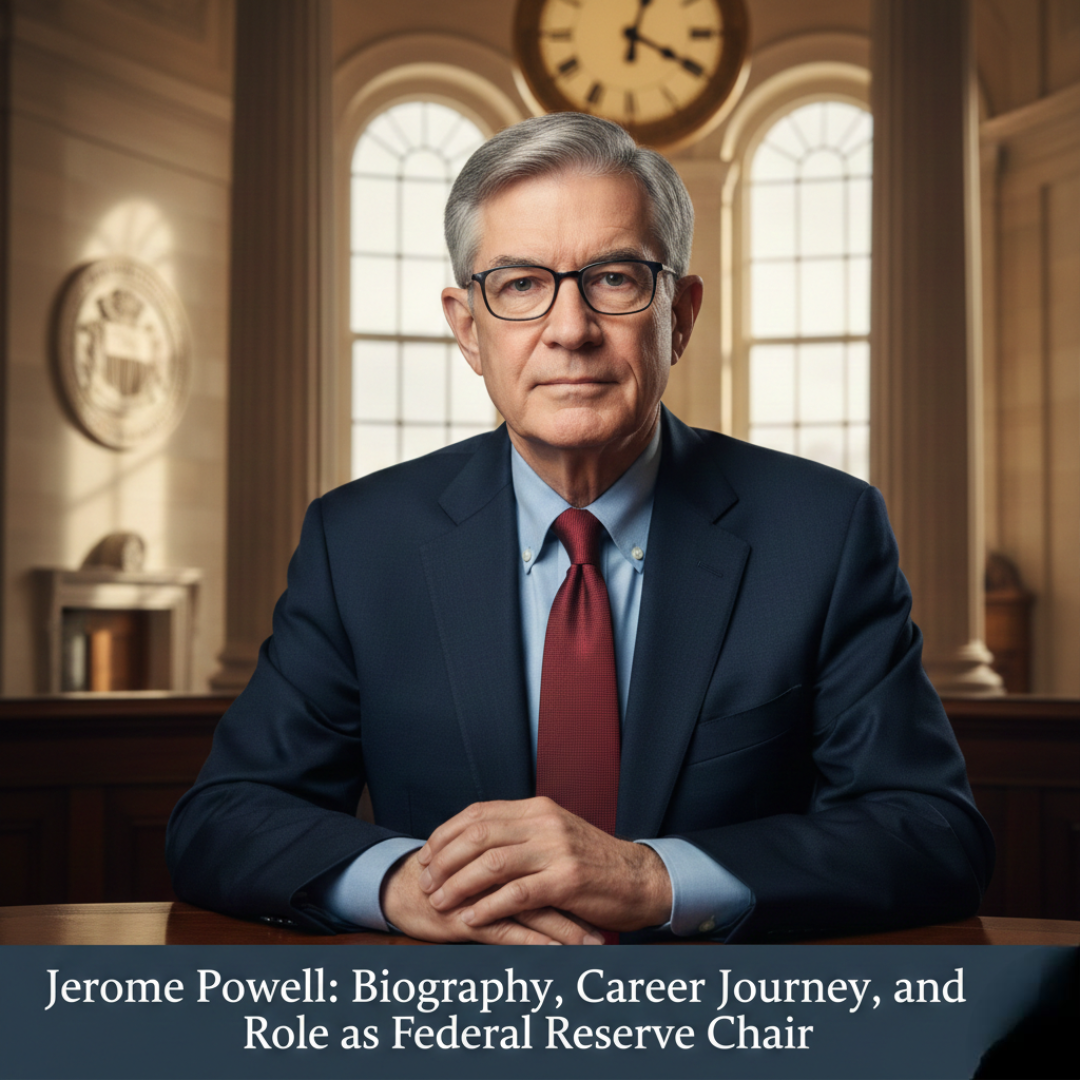
Jerome Powell is one of the most influential economic leaders in the modern world. As the Chair of the U.S. Federal Reserve, his decisions directly affect interest rates, inflation, employment, and global financial markets. Understanding Jerome Powell: Biography, Career Journey, and Role as Federal Reserve Chair helps explain how economic policy shapes everyday life.
Powell stands out because he is not a traditional academic economist. Instead, his background in law, finance, and public service has shaped a pragmatic leadership style that balances economic theory with real-world market experience.
Childhood and Family Background
Jerome Hayden Powell was born on February 4, 1953, in Washington, D.C., and grew up in a middle-class family. His upbringing emphasized discipline, public service, and education—values that later influenced his career choices and leadership approach.
Academic Journey
Powell earned his bachelor’s degree in politics from Princeton University. He later attended Georgetown University Law Center, where he received his Juris Doctor (JD). His education laid the foundation for his analytical thinking, legal expertise, and understanding of government institutions.
Work in Investment Banking
After completing law school, Powell moved into finance, working in investment banking. He gained firsthand experience with financial markets, risk management, and corporate finance—skills that would later prove critical at the Federal Reserve.
Experience in Law and Private Equity
Powell also worked as a lawyer and later joined a private equity firm. This mix of legal and financial experience set him apart from many central bankers and gave him a strong grasp of how businesses respond to economic policy.
Role at the U.S. Treasury Department
Jerome Powell entered public service during the early 1990s, serving as Under Secretary of the Treasury for Domestic Finance under President George H. W. Bush. In this role, he worked on debt management, financial regulation, and economic policy.
Key Responsibilities and Achievements
At the Treasury, Powell helped navigate complex financial challenges and developed a reputation as a steady, bipartisan policymaker focused on practical solutions rather than ideology.
Appointment to the Federal Reserve Board
In 2012, President Barack Obama nominated Powell to the Federal Reserve Board of Governors. His appointment reflected confidence in his financial expertise and balanced policy views.
Political Support and Confirmation Process
Powell received strong bipartisan support in the Senate, highlighting his reputation as a consensus builder respected by both political parties.
How and When He Became Fed Chair
Jerome Powell became Chair of the Federal Reserve in February 2018 after being nominated by President Donald Trump. His reappointment later confirmed confidence in his leadership across administrations.
Historical Significance
Powell was the first Fed Chair in decades without a PhD in economics, signaling a shift toward broader professional experience at the top of the central bank.
Responsibilities of the Fed Chair
As Fed Chair, Powell oversees U.S. monetary policy, supervises major banks, and represents the Federal Reserve before Congress and international financial institutions.
How Powell Leads the Federal Reserve
His leadership style emphasizes data-driven decisions, transparency, and clear communication to reduce uncertainty in financial markets.
Interest Rate Decisions
Powell has overseen both periods of low interest rates and aggressive rate hikes, adjusting policy based on economic conditions.
Inflation Control Strategies
Controlling inflation has been a defining challenge of his tenure. Powell has supported firm monetary tightening when necessary to restore price stability.
Approach to Economic Stability
His policies aim to balance inflation control with employment growth, reflecting the Fed’s dual mandate.
Leadership During the COVID-19 Pandemic
During the COVID-19 crisis, Powell took unprecedented action to support the economy, including near-zero interest rates and large-scale asset purchases.
Actions Taken to Stabilize the Economy
These measures helped prevent a financial collapse and supported recovery, earning Powell global recognition for decisive leadership.
Notable Successes
Powell’s crisis management during the pandemic and efforts to stabilize inflation are among his most significant achievements.
Criticism and Controversies
He has also faced criticism for reacting too slowly to rising inflation and for the impact of rate hikes on borrowers and financial markets.
Influence on Financial Markets
Powell’s statements alone can move stock, bond, and currency markets worldwide, showing the power of his role.
Global Economic Implications
Because the U.S. dollar is central to global trade, Powell’s decisions influence economies far beyond America.
How Investors and the Public View Powell
Many investors see Powell as a steady hand during uncertainty, while others debate the long-term effects of his policies.
Media Reactions
Media coverage often focuses on his press conferences, where his tone and wording are closely analyzed.
Decision-Making Approach
Powell favors consensus, careful analysis, and flexibility rather than rigid ideology.
Communication With Markets and Policymakers
He prioritizes transparency to guide expectations and maintain trust in the Federal Reserve.
Interests Outside of Work
Outside his professional role, he is known for supporting education and public service initiatives.
Long-Term Impact on the Federal Reserve
Jerome Powell: Biography, Career Journey, and Role as Federal Reserve Chair reflects a leader who reshaped crisis management and communication at the Fed.
What Lies Ahead for Jerome Powell
As economic conditions evolve, Powell’s legacy will be defined by how successfully he balances inflation control, growth, and financial stability in an uncertain global economy.
Frequently Asked Questions
Who is Jerome Powell?
Jerome Powell is an American financial leader and the Chair of the U.S. Federal Reserve. He is responsible for guiding the nation’s monetary policy and maintaining economic stability. Jerome Powell: Biography, Career Journey, and Role as Federal Reserve Chair highlights his unique path from law and finance to becoming one of the most powerful central bankers in the world.
What does Jerome Powell do as Fed Chair?
As Federal Reserve Chair, Jerome Powell leads the Federal Open Market Committee (FOMC), oversees banking regulation, and represents the Federal Reserve before Congress and global financial institutions. His job is to balance inflation control, employment growth, and overall financial stability in the U.S. economy.
How does Jerome Powell affect interest rates?
Jerome Powell plays a key role in shaping interest rate decisions by leading policy discussions and guiding the Fed’s strategy. While rates are decided collectively by the FOMC, Powell’s leadership, economic outlook, and public communication strongly influence when rates rise or fall, affecting mortgages, loans, and financial markets worldwide.
Is Jerome Powell still Federal Reserve Chair?
Yes, Jerome Powell continues to serve as the Federal Reserve Chair. His leadership remains central to U.S. monetary policy as the economy responds to inflation trends, growth challenges, and global financial pressures.